
Ambassador Ben Marc Diendéré: A Bridge-Builder Between Canada and Africa- Championing Economic Partnerships
Read this exclusive interview with Ambassador Ben Marc Diendéré on Canada-Africa economic partnerships, innovation, and diaspora leadership building bridges between continents. An inspiring testimony on the cultural and economic relations between Canada and Africa.
11/17/20255 min read

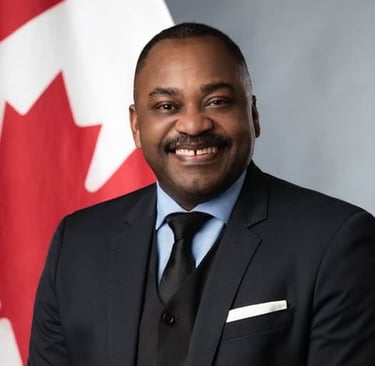
Interview
1. Role of technology and digital transformation
ABMD: Technology and digital transformation are powerful enablers of inclusive and sustainable development, and they are central to the success of Canada’s Africa Strategy. In education, digital platforms can drastically expand access to learning for youth in remote or underserved communities. In healthcare, telemedicine and digital health records can strengthen systems, improve delivery, and support early intervention, even in regions with limited infrastructure.
When it comes to economic diversification, digital tools can unlock new markets and accelerate the growth of Africa’s entrepreneurial ecosystem. From fintech to agri-tech, we are seeing a surge in African innovation. Canada could be a partner in co-innovation—not only transferring technology, but supporting local capacity building, digital literacy, and regulatory frameworks that support responsible digital growth. Our collaboration should focus on equity, inclusion, and sustainability to ensure no one is left behind.
2. Mobilizing private sector investment and fostering innovation
ABMD: In my role as Special Envoy, I have had the opportunity to witness the already significant presence of Canadian companies across the African continent. It is essential to dispel the myth that Canada is completely absent from business in Africa, a continent made up of 54 countries.
In Cape Town, at the Energy Summit, I led a delegation of 19 Canadian companies. In Algiers, at the IATF Assembly, there were 16 Canadian companies present. In Ghana, at the Diaspora Investment Forum, about ten Canadian companies participated.
We must start by supporting those who are already there. By valuing and strengthening this existing base, we can expand and deepen Canada’s economic engagement in Africa
Mobilizing private sector investment within the framework of Canada’s Africa Strategy requires a balance of vision and pragmatism. To unlock impactful economic partnerships, Canada must create an enabling environment that de-risks investments in emerging and strategic sectors such as agribusiness, green energy, digital services, mining, and the defence industry. These sectors align with Africa’s priorities while capitalizing on Canada’s unique expertise and industrial strengths. Here is a sectoral focus:
Focus on regions demonstrating:
Progressive regulatory environments;
Expanding markets and infrastructure development;
Established diplomatic and commercial ties with Canada;
De-Risking and Partnership Models: Attracting capital requires expanding the use of:
Blended finance mechanisms (via FinDev Canada, Export Development Canada, IDRC);
Public-private partnerships (PPPs) with risk-sharing frameworks and clear regulatory pathways;
Technical assistance and capacity building to support regulatory reform and project readiness;
Partner with Golf states and emerging Countries such Türkiye, India, Indonesia.
Building Innovation Ecosystems: Canada can uniquely foster innovation linkages through:
Joint innovation labs in agritech, cleantech, AI, mining tech, and defence solutions;
Business accelerators and incubators linking Canadian and African entrepreneurs and startups;
Knowledge exchange programs connecting researchers, universities, and industrial clusters.
This approach emphasizes co-creation, knowledge sharing, and scalability rather than one-way technology transfer.
Having worked in both public and private leadership roles, I’ve witnessed firsthand how aligning business incentives with long-term development goals drives sustainable, scalable impact. Canada’s Africa Strategy must champion these win-win partnerships, where innovation, investment, and development outcomes reinforce each other.
3. Fostering youth engagement and leadership
ABMD: Youth engagement is not just important—it is imperative. Over 60% of Africa’s population is under the age of 25. This is not a challenge; it’s an incredible opportunity. Within Canada’s Africa Strategy, we are prioritizing initiatives that amplify youth voices, support youth-led innovation, and build leadership capacity.
My approach involves creating platforms where young people are not only beneficiaries of programs but are co-designers and decision-makers. That includes support for skills training in high-demand sectors, investment in youth entrepreneurship, and greater inclusion of young leaders in policy dialogues between Canada and African nations. Empowering youth today means securing the future of our partnerships tomorrow.
4. Qualities needed for african diaspora leaders today
ABMD: Diaspora leaders are uniquely positioned to act as cultural, economic, and diplomatic bridges. But this role demands more than just professional competence—it requires:
Adaptability to navigate multiple contexts and shifting global realities;
Empathy to build authentic relationships across communities;
Integrity and humility, especially when engaging in international development and diplomacy;
Visionary thinking, because leadership today is not just about solving today’s problems but about shaping tomorrow’s possibilities;
Get out of political diaspora.
Diaspora leaders must also remain deeply connected to their roots while open to learning from and contributing to their host societies. In this way, they become true catalysts for inclusive and transformative change.
5. Guiding values on my Journey from Burkina Faso to Canada
ABMD: My journey—from Burkina Faso to becoming a public servant and business leader in Canada—has been anchored in a few core values: resilience, integrity, empathy, creativity, service, and curiosity.
Resilience helped me overcome barriers and adapt to new environments. Integrity ensured I remained true to my purpose and principles, even in moments of uncertainty. Empathy has allowed me to lead with compassion, to listen deeply, and to build meaningful connections across cultures and sectors. Creativity has been essential for finding innovative solutions in complex situations—whether in business strategy, diplomacy, or social engagement.
Service has always been at the heart of my leadership—motivating me to contribute to something greater than myself. And curiosity continues to drive me to learn, grow, and expand my understanding of the world.
These values shape not only how I lead, but also how I engage—with humility, with openness, and with a deep commitment to building bridges that create lasting, inclusive impact between Canada and Africa.
"One of my favorite thinkers, Boucar Diouf, who is Québécois of Senegalese origin, once said a quote that I really love…
Between my African roots and my Québécois foliage stands my Senegalese trunk.
I can say the same thing…
Between my African roots and my Canadian foliage stands my Burkinabè trunk."
Key points
Who is Ben Marc Diendéré? Ben Marc Diendéré is Canada's Special Envoy for Africa and Permanent Observer to the African Union in Addis Ababa. A Canadian-Burkinabé executive, he held leadership positions at VIA Rail Canada and Sollio Groupe Coopératif, and currently chairs UNICEF Canada.
What sectors are priorities for Canada-Africa partnerships? Strategic sectors include agritech, green energy, digital services, mining, and defense industry, aligned with African priorities and Canadian expertise.
Why is African youth important? Over 60% of Africa's population is under 25, representing a major opportunity for innovation, entrepreneurship, and sustainable economic development across the continent.
Ambassador Ben Marc Diendéré is a distinguished Canadian-Burkinabé executive, currently serving as Canada's Special Envoy for Africa and Permanent Observer to the African Union in Addis Ababa, Ethiopia.
In this pivotal role, he is at the forefront of strengthening diplomatic and economic ties between Canada and the African continent, leveraging his extensive experience in both the public and private sectors.
Ambassador Diendéré's career is marked by a profound understanding of strategic communications, public affairs, and brand management, coupled with a keen business acumen. Prior to his diplomatic appointment, he held significant leadership positions that underscore his business orientation and impact.
From 2020 to 2022, he served as Chief Public Affairs and Communications Officer at VIA Rail Canada, where he was responsible for the strategic direction and execution of internal and external communications, public affairs, media relations, and government and stakeholder relations.
His mandate also encompassed universal accessibility, sustainable development, and corporate social responsibility, demonstrating his holistic approach to business and societal impact.
Before VIA Rail, Ambassador Diendéré's business leadership was evident during his tenure as Senior Vice-President of Communications, Public Affairs, and Brand Management at Sollio Groupe Coopératif (formerly La Coop fédérée) from 2011 to 2019. In this role, he played a crucial part in shaping the bran d and public image of one of Canada's largest agri-food cooperatives.
He also honed his expertise in corporate strategy and public relations as Senior Director of Institutional Relations and Corporate Public Affairs at Quebecor Media from 2005 to 2011.
Beyond his professional and diplomatic roles, Ambassador Ben Marc Diendéré is deeply committed to community and economic development. He has served on numerous boards, including as Chair of UNICEF Canada (since 2022) and the Conseil des arts de Montréal (since 2020), showcasing his dedication to fostering growth and inclusion across various sectors.
His multifaceted career and current ambassadorial role position him as a key figure in driving mutually beneficial business and development initiatives between Canada and Africa.